
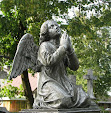
La llorona is a very creepy legend of Latin American countries, and parts of the United States as well. La Llorona is the name for the Weeping Woman in Mexico and parts of the United States. Imagine that you have born children by your dearest love, whether he is your husband or not. He cruelly tells you he is leaving you because he does not want to be a father, or doesn't want you anymore. He may be abandoning you for another woman or to marry a more socially acceptable woman. Or perhaps a new lover won't take you if you have children. What does a mother do? Well don't do what La llorona did. She drowned her children and will pay the price for eternity.
La llorona is a spirit that haunts the riverbeds, doomed to look for her drowned children for eternity. In many of the myths, the woman drowns her children and herself. When she gets to Heaven, the Lord asks where her children are. She doesn't know, so He tells her to walk the earth in search of them.
In some myths she has the head of a horse, and may wear black or white-bloodstained rags. She might steal children. In the Guatemalan myth, she has a loud weeping cry that will send chills down your spine. She tends to be present at wells and in wandering in the mountains. In the Honduran myth, she is known as La Sucia, or the Dirty Woman. She might take the form of a wife or lover, and if you realize it's her, she will scratch out your eyes with her long nails. In an alternate version of the Honduran legend, La Sucia is an abandoned married woman who seduces men by the river. She looks beautiful and young initially, but changes into the form of an old woman. The sight of which, drives the men insane. She has a popular cry that is translated as "Drink of my breast, for I am your mother." En El Salvador, she is said to cry "Where is my children?"
In Panama she is called "La Tulivieja." She was a young woman married to an important businessman who left her baby in what she thought was a safe place under a tree, only to find him gone when she returned for him. For her negligence, she was cursed by God with a hideous face with holes, long hair all over her body, and chicken feet. In Chile she wears white and is seen by people who are about to die, people with special abilities like medicine men, or by animals with heightened senses. She is the guide of the dead and also cries for the dead so that they won't haunt their living relatives. She is said to hypnotize men into spending the night with her to comfort her for her lost child. If you rub your eyes with tears from a dog, you can see her, but you must be brave, or the vision will be a horrible one.
Essentially, La Llorona is used as a cautionary tale to keep wayward children in line, or to prevent a young girl from being easily enticed by empty promises of men. Some believe that to hear the cry of the Weeping Woman is to be doomed for death.
The legend of La Llorona can be traced by to Medea, the Greek legend of a sorceress who killed her children she had with the adventurer Jason, when he abandoned her. The Aztec goddess Coatlique appeared before the arrival of the invading Spanish conquistadors under Hernan Cortes. She was said to be weeping for her lost children. This was an omen of the fall of the Aztec empire. The legend of the Weeping Woman is also said to be related to the story of La Malinche, an Indian woman who acted as a mistress for the conquistador Cortes, and who subsequently sought vengeance when abandoned her and their child for a Spanish lady.
Although the legend is slightly different depending on what country you are in, each telling is chilling. The idea of a woman who kills her children, dies, and is cursed to wanders the riverside on dark, lonely nights; weeping, and possibly looking for victims, certainly makes a person want to stay inside and far away from any bodies of water.
References
La Llorona-Wikipedia, The Free Encyclopedia. http://en.wikipedia.org/wiki/La_llorona. Last modified 20 October 2008. Accessed 20 October 2008.
Monday, October 20, 2008

Saturday, October 4, 2008
R is for Red Cap

I was watching my Hellboy Animated Blood and Iron DVD special features and there was a little animated short on it, based on the folkcreature, a red cap. It perked my interest, and also gave me a chill. Folklore is not always inhabited by happy, friendly, frolicking creatures that mean no harm. There definitely creatures of menace and evil, who gleefully do harm to humans and other unsuspecting beings. The red cap is one of them.
According to Sprits, Fairies, Leprechauns, and Goblins: An Encyclopedia of the Little People by Carol Rose, the red cap, also called the bloody cap, is an evil goblin or sprite from the folklore of the borderlands between England and Scotland. The borderlands are ripe with stories of this evil sprite. It lives in the ruins of castles and fortified towers, where previous battles have occurred, and blood has been shed.
In appearance, it looks like an extremely diminutive old man, with hair that is long and unkempt, red eyes, hideous talons on skinny fingers, and protruding teeth. His boots are made of iron, and he wears a cap that is red and blood-soaked.
According to Wikipedia, the red cap, also called a powrie or dunter, has to continually kill in order to dye his cap in blood, as the color will fade. His iron shoes make him very fast, making them quite impossible to outrun.
If a lost traveler happens to come across a red cap in the ruins of a castle, he is a very unfortunate person indeed. The red cap lies in wait to savagely kill him, catching the blood of his unfortunately victim in his cap. The intended victim has the opportunity to escape if he is able to recite the scriptures. This will cause the red cap to shriek and disappear. One of his fangs will be left behind.
If your interest in red caps. has been sparked, Wikipedia lists the following books and media the feature red caps:
- Hellboy comic "Iron Shoes" by Mike Mignola
- DemonWars Saga by RA Salvatore
- Mage: The Hero Rediscovered graphic novel by Matt Wagner
- Meredith Gentry books by Laurell K. Hamilton
- Fables Volume 2 gothic novel
- Spiderwick Chronicles books
- The Dark Age and Kingdom of the Serpent by Mark Chadbourn
- Harry Potter series by J.K. Rowling
So if you happen to visit Scotland and get lost, remember not to seek shelter in any castle ruins. I think a night spent outside in the elements is a lot safer than encountering one of these beasties. If you think a cold Scottish night outdoors is too much for you, the alternative is to memorize a few scriptures on the flight over.
References
Rose, Carol. Sprites, Fairies, Leprechaun: An Encyclopedia. Page 43. Published by W.W. Norton & Company. N.Y, N.Y, 1996.
Red Cap-Wikipedia, The Free Encyclopedia. http://en.wikipedia.org/wiki/Red_Cap. Date accessed 4 October 2008. Last modified 16 September 2008.
Thursday, October 2, 2008
D is for Doppleganger

For some reason, when I think of dopplegangers, a chill just runs right down my spine. Perhaps it is that feeling of the unknown touching you personally. I lot of people have told me they know someone who looks just like me. I really don't like the thought of it, but maybe I do have a doppleganger.
A doppleganger is a double of a person, and tends to be regarded as bad luck. Usually to see a doppleganger means that a person may die soon. According to Wikipedia, Norse mythology has a vardoger, which is a ghostly double of a person who is seen performing their actions before the actual person does. Or the person may arrive later, to find that his friends or family are confused because he had already came and went.
In history, Abraham Lincoln was reported to have seen his doppleganger in the mirror, a sign he would not live through his second term in office. Other reports include the famous poet Thomas Donne seeing a doppleganger of his wife the night she gave birth to a stillborn child, although he was in a different city than her.
According to Halloween Web, there is a theory that everyone has a double. One is good, and one is extremely evil. It also states the many times the doppelganger is seen by someone else, instead of the person who is doubled, leading to confusion. This gives the effect of being in two places at once.
Interested in reading fiction or watching television or movies that involve doppelgangers?
- The Double by Fyodor Dostoyevsky
- Invisible Man by Ralph Ellison
- William Wilson by Edgar Allen Poe
- Doppelganger by Maire Brennan
- Heroes TV show has a character named Jessica with an evil doppleganger called Niki who manifests as part of her own psyche, and has supernatural strength.
- Buffy the Vampire Slayer TV show character Willow has an evil doppelganger in an alternate reality known as "Evil Willow"
- The movie Silent Hill has a child named Alessa who's doppleganger is called Dark Alessa, and has frightening telepathic powers
- Dopplegangsters short story by Laura Resnick in the Murder by Magic: Twenty Tales of Crime and the Supernatural Anthology has supernaturally-bumped off mobsters appearing as dopplegangers minutes before their demise.
Are your friends saying that you seem to be in two places at once? Did you rudely insult your boss, only it wasn't you? You might have a doppleganger who's out to cause mischief for you. If you don't want to believe, then just hope that the double image that you see out of the side of your eye is just a sign that you need glasses. The truth could be too frightening to accept.
References
Doppelganger-Wikipedia, the Free Encyclopedia. http://en.wikipedia.org/wiki/Doppelganger. Accessed 2 October 2008. Last modified 2 October 2008.
Doppelgangers Legend. Halloween Web.
http://www.halloween-website.com/doppelgangers.htm. Accessed 2 October 2008. Copyright 2003-2008.
What is a Doppleganger? Wisegeek.com. http://www.wisegeek.com/what-is-a-doppelganger.htm. Niki Foster. Conjecture Corporation. Accessed 2 October 2008. Copyright 2003-2008.
Wednesday, October 1, 2008
B is for Banshee
 Image taken from Irish Fairies: Banshee http://www.irelandseye.com/animation/explorer/banshee.html
I have always been fascinated with banshees, probably because of my Irish ancestry. They are equally eerie to me. I get the creeps thinking of seeing a pale, long-haired woman in a rotting cloak, wailing and pointing at me on a dark and dreary night. Sheesh!
According to the website, Irelandseye: A Field Guide to Irish Fairies, Banshees, or bean-sidhe, are faery women or ancestral spirits that are assigned to certain families to forewarn their members of their time of death. The five major families that the banshees were said to cry for are: O'Neill, O'Brien, O'Connor, O'Grady, and the Kavanaugh. However, this list has been lengthened by intermarriage (so don't think you're off the hook.) According to Wikipedia, the banshee is sometimes not a fairy, but the ghost of a murdered woman or a woman who died in childbirth.
The Field Guide to Fairies states that the banshee can appear in three major forms: a young woman, a bedraggled old crone, or a matronly woman. This is in representation of the triple aspects of the war and death goddess of Celtic mythology, Badhbh, Macha, and Mor-Rioghan. The banshee can also appear in animal forms, such as hares, weasels, and hooded crows, which are associated with witchcraft in Ireland.
Wikipedia states that banshees are frequently described as having long, fair hair, which they will brush with a silver comb. This relates to a very old Irish story that you should never pick up a silver comb laying on the ground, for the banshees (or mermaids, depending on the tale) will place it there to lure an gullible human away, likely to their death or to be stolen away to the land of Faery.
The banshee will typically be dressed in a hooded cloak of gray or the grave robe of people who died without receiving Last Rites. In some instances, she may appear as a washer-woman, washing the blood-stained garments of the unfortunate soul who is about to die. When a banshee appears as a washing-woman, she is called a bean-nighe. According to Wikipedia, the Scottish call the banshee a bean-nighe.
The Field Guide states that sometimes a banshee may not even be seen. Instead, her wailing can be heard when someone is about to die. The banshee's wail can be so piercing that it can shatter glass. It is said that King James I of Scotland was told by a banshee that he would be murdered in 1437. Wikipedia states that according to legend, the banshee will wail around the house of the person who is about to die.
Although banshees are very much a part of Irish and Scottish folklore and legend, they have found their place in modern fiction. For instance, Seamus Finnigan, one of the Irish students in the Harry Potter stories, saw a banshee, and screeching was heard in Harry Potter and the Goblet of Fire that was attributed to banshees.
Banshees may be associated with the five great Irish families, but many Americans have Irish heritage. Who is to say that a banshee may not come to foretell of one our demises on a dark, gloomy night? I hope I never find out.
References
Banshee. Irelandseyes: A Field Guide to Irish Fairies. http://www.irelandseye.com/animation/explorer/banshee.html. Accessed 1 October 2008.
Banshee-Wikipedia, the Free Encyclopedia. http://en.wikipedia.org/wiki/Banshee.
Accessed 1 October 2008. Last Modified 29 September 2008.
In Honor of October: Creatures that Go Bump in the Night

Since October is the month of Halloween, I will be spotlighting the more scary of the creatures that dwell within the folktales and myth stories. Fear is in the eye of the beholder, but I find these creatures either creepy, sinister, or down-right scary. So join us, and don't read this blog before bedtime.
Imagine Vincent Price laughing eerily right now!
Thursday, September 4, 2008
G is for Golem
 Image is a photo of a statue depicting the Prague golem. Taken from http://commons.wikimedia.org/wiki/Image:Clay-golem.jpg
The golem is a creature of Jewish folklore. According to The Golem by Alden Oreck, the term golem means "shapeless mass" in Hebrew. It is made of clay but animated to life. The Ultimate Encyclopedia of Mythical Creatures states that golems can also be made out of wood or mud. However, it is of limited intelligence, and will only follow the directions of its creator. To possess a golem was thought to attribute wisdom and holiness to the owner. In order to be able to create a golem, its creator is closer to God, who is the Creator, than other humans. One of the most famous golems was said to be created to protect the Jewish residents of the Prague ghetto from persecution, created by Rabbi Judah Loew the Maharal. As it gains strength, it goes on a Gentile killing spree.
In many tales, the golem has magic words inscribed on its head to bring it to life. It is said that the one of the names of God is written on a scrap of paper and attached to the golem's head or directly into the clay, will animate it, and when the creator wants to inactivate it, the name is erased. Emet, which means "truth of God" can be written to animate the golem. When it is time to stop its life, the e can be erased to form the word met, which means "death." Another method is to write the name of the creator of the golem in blood on a sheet of calfskin, and to put it in its mouth. Deactivation can be accomplished by removing the paper from its mouth.
It is said that golems must rest on the Sabbath or they will go beserk. And the creator/controller of the golem must take care in the instructions given to the golem, for they will be taken perfectly literately. According to the Maharal story, the golem has magical powers such as invisibility, summoning the dead, and a heated touch.
According to The Ultimate Encyclopedia of Mythical Creatures, the rabbi who created a golem would often be punished for attempting to "play God." Mary Shelley's Frankenstein is a more modern retelling of this cautionary tale.
Golems in Books and Other Media:
In many tales, the golem has magic words inscribed on its head to bring it to life. It is said that the one of the names of God is written on a scrap of paper and attached to the golem's head or directly into the clay, will animate it, and when the creator wants to inactivate it, the name is erased. Emet, which means "truth of God" can be written to animate the golem. When it is time to stop its life, the e can be erased to form the word met, which means "death." Another method is to write the name of the creator of the golem in blood on a sheet of calfskin, and to put it in its mouth. Deactivation can be accomplished by removing the paper from its mouth.
It is said that golems must rest on the Sabbath or they will go beserk. And the creator/controller of the golem must take care in the instructions given to the golem, for they will be taken perfectly literately. According to the Maharal story, the golem has magical powers such as invisibility, summoning the dead, and a heated touch.
According to The Ultimate Encyclopedia of Mythical Creatures, the rabbi who created a golem would often be punished for attempting to "play God." Mary Shelley's Frankenstein is a more modern retelling of this cautionary tale.
Golems in Books and Other Media:
- Gustav Meyrink's The Golem, based on the story of Rabbi Judah Loew the Maharal
- Isaac Bashevis Singer also wrote a version of the golem myth
- The Amazing Adventures of Kavalier and Clay by Michael Chabon
- The Barmtimaeus Trilogy by Jonathan Stroud
- Feet of Clay by Terry Pratchett
- Snow in August by Pete Hamill
- The Puttermesser Papers by Cythia Ozick
- Iron Council by China Mieville
- Dragon Tears by Dean Koontz features a villian with the supernatural ability to create golems out of dirt
- Foucault's Pendulum by Umberto Eco
- A Calculus of Angels by Gregory Keyes
- The Tortuous Serpent by Donald Tyson
- The Image Comics title Proof features a golem named Joe
- A series of German silent expressionism movies were made based on the golem myth
- Episodes of Gargoyles, X-Files, and Charmed have been built around the golem myth
The mythical golem is viewed as a sign of wisdom and holiness, revered as a savior for the persecuted Jews, and also can be seen as a sign of reaching beyond one's natural limits. It serves as a powerful metaphor for creation, but can also be used for destruction. The golem is deeply entrenched in Jewish folklore, but it has crossed over into the collective imagination, finding its way into tales enjoyed by many outside of the Jewish consciousness.
References
Golem-Wikipedia, The Free Encyclopedia. http://en.wikipedia.org/wiki/Golem. Accessed 28 September 2008. Last Modified 26 September 2008.
Dempsey, Colin. The Ultimate Encyclopedia of Mythical Creatures. Published by Barnes & Noble, Inc., 2006. p. 87-88.
The Golem by Alden Oreck. Published by Jewish Virtual Library, A Division of the Israeli-American Cooperative. http://www.jewishvirtuallibrary.org/jsource/Judaism/Golem.html. Accessed 28 September 2008. Last modified 2008.
Tuesday, September 2, 2008
D for Djinn


This image was taken from Amazon.com, http://amazon.com. This is the cover for the first book in the Bartimaeus Trilogy, The Amulet of Samarkand, by Jonathan Stroud.
The Djinn, aka jinn, is a supernatural being, an elemental that is said to possess free will. Most of us are most familiar with the term genie, which was first used in English in 1665, with the translation of The Book of One Thousand and One Nights by French translators. The root of the original root of jinn is said to come from the Semitic root "JNN" which refers to hidden or concealed.
Djinn were worshipped as tributary spirits by pre-Islamic Middle Eastern Cultures. They were associated with succubi (demons who take the form of beautiful women). A female djinn is called a "Jinniyah" or "Jinneyeh."
The djinn are mentioned in the Koran, and form an important of some Islamic practitioners' beliefs. They are said to be made from "smokeless fire" by Allah, as humans were made from earth. According to Spirits, Fairies,Leprechauns, and Goblins: An Encyclopedia, by Carol Rose, the djinn were made from the Sharan wind (Simoon). Because of their substance of smokeless fire, they are invisible to humans, and also they possess the ability to fly. Because they have free will, they can follow any religion they choose to follow. Like humans, the djinn will be judged on the Day of Judgment, being sent either to Hell or Heaven, according to their deeds in life. In Islam, the Devil or Satan is a djinn called "Shaitan" or "Iblees."
The djinn also crop up in the Old Arabic and Old Persian Bibles in the following books, Leviticus, 1st Samuel, 1st Corinthians, and the gospels Matthew, Luke, and John, as Jinn or Jaann.
Outside of religious history, they also have a long and powerful history in popular media. How many us watched "I Dream of Jeannie" growing up? Enough said.
Because of their free will, not all djinn are good, and not all are evil. As some djinn possess almost limitless power, I would not like to run into an evil djinn!
Rose states that Djinns may take any shape, even large ones, and can be hideous in form or beautiful. One can tell that he or she is encountering a djinn in human form by the shape of its eye pupils (vertical like goats). But this is probably too late for you to get away at this point!
Benevolent djinn have been known to fall in love with and mate with humans, producing offspring that can walk through walls, fly, and age slowly.
In Morocco, it is believed that every human has their own djinn. Those Earth djinn who are independent live in dark and isolated environments, such as lavatories, drains, and cemeteries. Because they are easily offended, if one disturbs their home, it will cause them to exact a "terrible retribution." Water djinn love to entice people to their watery deaths. In contrast, tree djinns are very benevolent towards humans, with exception of the fig tree djinns, which incite quarrel.
The major types of djinn:
- Marid : The strongest type of djinn, associated with seas or oceans, where it is typically found. Arrogant in nature, it is susceptible to flattery, and can be coaxed to do chores either through summoning via rituals by powerful magicians, via flattery, through imprisonment, or by engaging in battle with it.
- Ifrit: in popular culture, it is represented to embody fire.
- Ghul or Ghoul: probably the most frightening type of djinn. Capable of shapeshifting, it lives in the desert, assuming the form of an animal, and lures unwary travellers into the desert to slay and eat them. It also robs the grave and eats the dead. As such, the term is often used for undead creatures who feed on the dead. They have a life of their own in the fictional words of horror, outside of their djinn origins.
When most of us in the Western world think of djinn or genies, we think of them as wish-giving creatures. This is due in large part to the portrayal of djinn in the story of Aladdin, from The Book of One Thousand and One Nights (the genie in the lamp). Another djinn is found in the story of The Fisherman and the Jinni.
When it comes to djinn, it is very important to remember to be careful what you wish. A djinn, much like a faery, will use one's words against that person. Typically your wish will come back to haunt you, or you will use the last precious third wish trying to reverse the prior wishes. If you don't believe me, read "The Monkey's Paw" by W.W. Jacobs.
If I have sparked your interest in the djinn, then you may want to read the following fiction books:
- The Arabian Nights (otherwise known as One Thousand and One Nights. I humbly suggest Tales from the Arabian Nights by Andrew Lang. It's pretty cool in that it uses a story in a story format. Very few of the stories just end cold.
- Practical Demonkeeping by Christopher Moore
- Dog Days by John Levitt features ifrit djinn
- Jadis from the Chronicles of Narnia by CS Lewis thought to be half-djinn.
- Declare by Tim Powers is an intriguing mix of spy story and djinn.
- The Sandman collection: Fables and Reflections by Neil Gaiman has several referrences to djinn.
- American Gods by Neil Gaiman features an ifrit taxi driver
- The Bartimaeus Trilogy by Jonathan Stroud
- The Weather Warden series by Rachel Caine features djinn as the source of power to the Wardens.
- Dragon Rider by Corneila Funke
- Children of the Lamp series by P.B. Kerr
- Jinn by Matthew Delaney is been described as "Saving Private Ryan meets Alien."
- The Forbidden Game trilogy by L.J. Smith
- Castle in the Air by Dianna Wynne Jones
- The Doctor Who novel The Stone Rose puts a new spin on the idea of a genie, Doctor Who-style.
- Proven Guilty, Book 8 of The Dresden Files by Jim Butcher features a jann.
Movies and TV featuring Djinn
- The aforementioned I Dream of Jeannie
- The Arabian Nights miniseries (fantastic)
- The 7th Voyage of Sinbad
- Two episodes of The Twilight Zone: "The Man in the Bottle," and "I Dream of Genie"
- Wishmaster (for the horror movie fans)
- Kazaam
- Special Unit 2 had an episode called "The Wish" with an evil genie who had to carry out wishes physically with disastrous consequences for the wish-maker.
- The Brass Bottle
- The "Je Souhaite" episode of X-Files features a very bored, but impish genie who brings nothing good to the person who acquires her.
- Long Time Dead (An ancient, evil djinn is featured in this horror film)
- The Thief of Baghdad
- A Thousand and One Nights
- Disney's Aladdin
- The "What is and What Should Never Be" episode of Supernatural the TV show has a djinn that does not grant wishes, but merely makes the victim dream his/her wish was granted, and feeds off the person's lifeforce. This djinn is truly horrifying in appearance.
..And djinn also make their appearance in comic books, manga, and the gaming world.
Well I hope that you know a little more about djinn. Remember, if a mysterious being appears after you acquire a certain object and asks you what you desire, remember to think twice what you wish for!
Bibliography
Genie- Wikipedia, The Free Encyclopedia. http://en.wikipedia.org/wiki/Djinn. Last modified 29 August 2008. Accessed 2 September 2008.
Ifrit-Wikipedia, The Free Encyclopedia. http://en.wikipedia.org/wiki/Ifrit. Last modified 1 September 2008. Accessed 2 September 2008.
Marid-Wikipedia, The Free Encyclopedia. http://en.wikipedia.org/wiki/Marid. Last modified 9 August 2008. Accessed 2 September 2008.
Ghoul-Wikipedia, The Free Encyclopedia. http://en.wikipedia.org/wiki/Ghoul. Last modified 25 August 2008. Accessed 2 September 2008.
Rose, Carol. Spirits, Fairies, Leprechaun, and Goblins: An Encyclopedia. W.W. Norton Publisher. p. 87-88.
Subscribe to:
Posts (Atom)